![]()
OpenAI
CEO Sam Altman along with company leaders from
Microsoft
Meanwhile, chip manufacturer Advanced Micro Devices provided testimony on Capitol Hill regarding the most significant prospects, challenges, and requirements confronting an industry that both policymakers and experts believe has the potential to radically reshape international commerce, societal norms, and political landscapes globally.
The hearing takes place as the competition to dominate the future of artificial intelligence intensifies among corporations and nations. Altman’s OpenAI is fiercely racing against technological adversaries such as Alphabet and Meta, alongside facing stiff challenges from AI models created by their counterparts in China.
"I think this could be at least as significant as the internet, possibly even larger," Altman stated during his introductory comments regarding AI's capacity to reshape society. "To achieve this, investing in infrastructure is essential." He encouraged the senators to facilitate the arrival of the "twin revolutions" in artificial intelligence and energy generation, which he believes will bring about profoundly beneficial changes to our way of life.
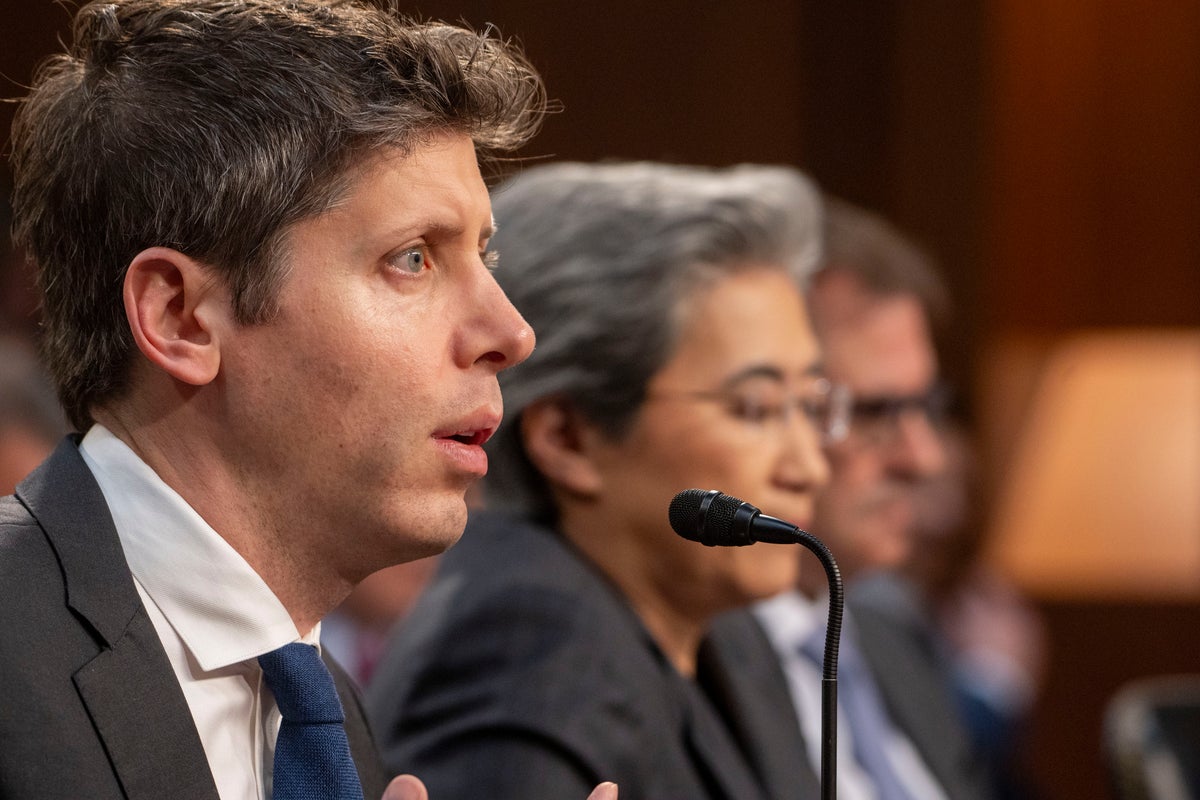
The witnesses included Altman; Lisa Su, chief executive of semiconductor maker AMD; Michael Intrator, co-founder of AI cloud computing startup CoreWeave; and Brad Smith, vice chair and president of Microsoft. They four executives unanimously urged lawmakers to help streamline policy for AI-related projects and fundraising.
The discussion covered a wide array of subjects including disputes within the sector regarding microchip efficiency, employment issues, interpersonal connections, and electricity production, as well as broader concerns about international rivalry.
China
and the European Union.
Sen. stated that China intends to be the global leader in AI by 2030,
Ted Cruz
, who chairs the Senate Commerce, Science and Transportation Committee. "In this competition, the United States stands at a crossroads. Will we follow the path that upholds our legacy of entrepreneurial spirit and tech-driven advancement? Or will we opt for the regulated approach seen across the pond in Europe?"
The senators generally displayed serious demeanor during their questions and showed consensus regarding their worry about ensuring the U.S. retains leadership in artificial intelligence. Members of both political parties likewise expressed worries pertaining to cybersecurity threats, safeguarding personal information online, as well as AI’s potential for generating material capable of causing confusion or deception among individuals.
Certain disagreements emerged among the parties involved. Senator Bernie Moreno, a Republican from Ohio, questioned Su and Smith about whether the sustainability initiatives pushed by the Biden administration were impeding efforts to generate additional power for AI-driven infrastructures.
Sen. Tammy Duckworth, a Democrat from Illinois, condemned the reductions in federal funding initiated by President Donald Trump and billionaire Elon Musk. These cuts affect institutions such as the Energy Department’s national labs and the National Science Foundation, which she described as "self-sabotaging attacks."
"Is there anyone who genuinely believes that if DOGE had existed decades ago, they wouldn’t have trimmed the project that led to the creation of the internet, citing it as an example of wasteful, publicly funded research and development?" asked Duckworth.
However, even with occasional sharp comments, the hearing kept a laid-back atmosphere and included some good-natured bi-partisan jokes as both legislators and business leaders talked about a technology everyone in attendance acknowledged would shape humanity’s destiny.
Take into account that this is a competition, yet we must grasp the reason behind our pursuit," Senator Brian Schatz from Hawaii, who belongs to the Democratic Party, stated to those testifying. "This isn’t merely about beating competitors in either the public or private sectors for some commercial advantage; rather, we aim to secure victory such that American principles triumph.
Trade policy and AI
A number of executives cautioned against implementing U.S. export restrictions that might inadvertently drive other nations towards adopting China's artificial intelligence tech instead.
"We completely grasp the significance of national security within our industry," Su stated. However, she also noted that without being able to "get our technology embraced globally, alternative solutions will emerge." These alternatives may currently lag behind technologically but will likely develop further over time, according to her remarks.
Altman explicitly linked the U.S.'s capacity to draw global talent with its worldwide product sales capabilities to both national security and its international clout.
The influence and advantage the U.S. gains from everyone preferring iPhones globally, along with Google being their top choice for searches, is enormous," Altman stated. "While perhaps not discussed as frequently, the desire to utilize semiconductor technology and other foundational elements produced domestically shouldn’t be underestimated either. We ought to strive towards global adoption of America’s complete technological ecosystem.
The trade competition between the U.S. and China has exerted significant pressure on the artificial intelligence sector, affecting companies like Nvidia and AMD based in California.
In April, the Trump administration declared new limitations on the sale of Nvidia’s H20 chips and AMD’s MI308 chips to China.
NVIDIA has stated that the stricter export regulations will result in an additional expense of $5.5 billion for the company. Following the announcement of their latest financial quarter, AMD revealed that these measures will lead to a loss of approximately $1.5 billion in revenue over the next few months.
The impact of extra AI chip regulations introduced during ex-President Joe Biden’s tenure remains unclear. These rules, slated for implementation next week, aim at over 100 nations. They have sparked significant backlash from firms like Nvidia along with various technology corporations. However, they've garnered support from entities such as AI firm Anthropic, which views them as necessary measures against China’s sophisticated methods involving the procurement of chips through shell enterprises based in other countries.
The Commerce Department stated via email on Thursday that Trump intends to substitute Biden’s "excessively complicated and excessively administrative" regulation with a more straightforward version; however, they did not specify a timeline for this change.
Expansion of AI data centers and rivalry among states
The day prior to the hearing, Altman went to the location in Abilene, Texas, where the extensive Stargate data center facility for OpenAI is under construction in partnership with Oracle and additional collaborators. This site was selected due to its promising proximity to multiple energy sources such as wind and solar power.
During the hearing, Altman stated that Texas had done an "extraordinary job" in attracting significant AI initiatives through incentives. "Other states should consider looking into this," he added. Altman also forecasted that the location in Abilene would become "the biggest AI training center globally."
However, Altman subsequently warned against adopting a fragmented regulatory approach for AI.
It’s extremely challenging to envision us navigating through 50 distinct regulatory frameworks," stated Altman. "A lightweight, unified national approach that we can comprehend easily would allow us to proceed at the pace required for this current era, which appears both significant and appropriate.
Although the tech sector has traditionally depended on data centers for operating web-based services such as emails, social platforms, and monetary exchanges, recent advancements in AI technology supporting widely-used chatbots and generative AI applications demand significantly greater computational power both for development and deployment.
A report published by the Department of Energy towards the end of last year indicated that the power required for data centers within the United States has increased threefold during the previous ten years. It also predicts this demand may double or even triple once more by 2028, potentially reaching as high as 12 percent of total national electricity consumption at that time.
——
The Associated Press has entered into a licensing and technology pact with OpenAI, granting OpenAI permission to utilize portions of AP’s textual archive resources.
——
AP Technology Writer Matt O'Brien provided additional reporting from Providence, Rhode Island.
Independent readers are free-thinking global citizens who aren’t categorized by conventional demographics or labels; instead, they’re characterized by their perspectives. Amidst our ever more segmented society, communities cherish genuine data and straightforward viewpoints shared directly through an unbiased news source they find trustworthy. Empowered and motivated by this knowledge and encouragement, independent readers feel ready to advocate for what they hold dear.


Comments
Post a Comment