The Role of Nuclear Energy in Sustainable Development
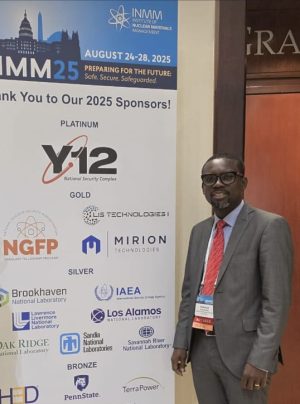
Prof. Francis Otoo, Acting Director General of the Ghana Nuclear Regulatory Authority (NRA), has called on developed countries to increase their efforts in sharing knowledge and reducing barriers that hinder African nations from accessing advanced nuclear technologies for peaceful purposes. His remarks were made during a panel discussion at the 66th Annual Meeting of the Institute of Nuclear Materials Management (INMM), which took place from 24 to 28 August 2025 in Washington, USA.
Prof. Otoo emphasized that for many countries in Africa and the Global South, nuclear energy is not a luxury but a necessity. He highlighted its crucial role in addressing significant challenges such as energy poverty, climate change, food insecurity, and access to healthcare. For these regions, nuclear technology offers a viable pathway toward sustainable development and long-term stability.
Nuclear Energy and the Non-Proliferation Treaty
He pointed out that Article IV of the Non-Proliferation Treaty (NPT) is not just a bonus for developing nations; it is the core of the treaty. The credibility of the NPT depends on its ability to deliver practical cooperation on peaceful nuclear uses while maintaining strong safeguards under Article III. This was the focus of the panel discussion titled “Peaceful Uses of Nuclear Energy, Science, and Technology – The Nexus between Articles III and IV of the Treaty.”
Prof. Otoo explained how nuclear applications are already making a direct impact on sustainable development in Africa. Beyond electricity generation, peaceful nuclear technologies are being used in cancer care, food security, clean water management, and industrial innovation. He cited initiatives like the IAEA’s Rays of Hope program, which aims to expand cancer therapy, and Atoms for Food, which supports agriculture and nutrition, as examples of how nuclear science is transforming lives.
Progress and Challenges in Nuclear Development
Prof. Otoo stressed that the 2026 NPT Review Conference must show visible progress in expanding such initiatives so that no vital projects are left unfunded. He also addressed concerns about regulatory capacity, noting that Africa is steadily building robust oversight systems to ensure the safe and secure deployment of nuclear technologies.
Through the Regulatory Cooperation Forum (RCF) and the Forum of Nuclear Regulatory Bodies in Africa (FNRBA), African regulators are aligning with IAEA standards and preparing for new technologies such as Small Modular Reactors (SMRs). Ghana, for instance, has benefited from strategic support from the USA, EU, IAEA, and bilateral partners to strengthen safeguards, nuclear safety, security, and transparency.
This shows that with sustained partnerships and peer-to-peer cooperation, the Global South is readying itself not just to use nuclear technology, but to regulate it responsibly, he emphasized.
Emerging Technologies and Global Governance
On the topic of emerging technologies such as advanced reactors, Prof. Otoo acknowledged both their potential and risks. He noted Africa’s leadership as the first nuclear-weapon-free zone under the Pelindaba Treaty, which provides a strong foundation for peaceful nuclear expansion.
He argued that the 2026 Review Conference must ensure that advanced reactors remain accessible, safe, and proliferation-resistant. This means removing barriers for newcomer states, encouraging supplier openness, and promoting more nuclear-weapon-free zones globally. Sovereignty must be respected while embedding collective safeguards.
A Call for Balance and Cooperation
Prof. Otoo concluded by calling for balance, stating that the NPT will only remain credible if Articles III and IV move in tandem with strong safeguards matched by real cooperation on peaceful uses. For Africa, nuclear technology is already improving health, food security, and energy access. The 2026 Review Conference must reaffirm this balance to keep the Treaty meaningful for all States.
Prof. Otoo shared the stage with leading experts, including Dr. Marco Marzo, Secretary General of the Brazilian-Argentine Agency for Accounting and Control of Nuclear Materials (ABAAC – Brazil), Ms. Gillian Gayner, Policy Analyst at the National Nuclear Security Administration (NNSA – Washington, USA), and Prof. Suresh Pillai, Professor of Microbiology at Texas A&M University, USA.
The session was chaired by Ana Claudia Raffo Caiado, an International Safeguards & Nuclear Non-Proliferation Expert at Oak Ridge National Laboratory, Tennessee, USA, who guided the discussion on global nuclear governance and its implications.
The Significance of the 2026 NPT Review Conference
The 2026 NPT Review Conference, scheduled to take place in New York, will be a decisive moment for the global nuclear order. With increasing geopolitical tensions, developing states like Ghana are urging that peaceful uses of nuclear science and technology remain at the core of the Treaty’s promise.


Comments
Post a Comment