The major parties have decided on a solution to Australia's housing crisis: build more homes. But some of the country's newest suburbs suggest it's not as straightforward as it seems.
The homes emerge from the verdant slopes in neat rows: robust and jagged, constructed of brick and concrete.
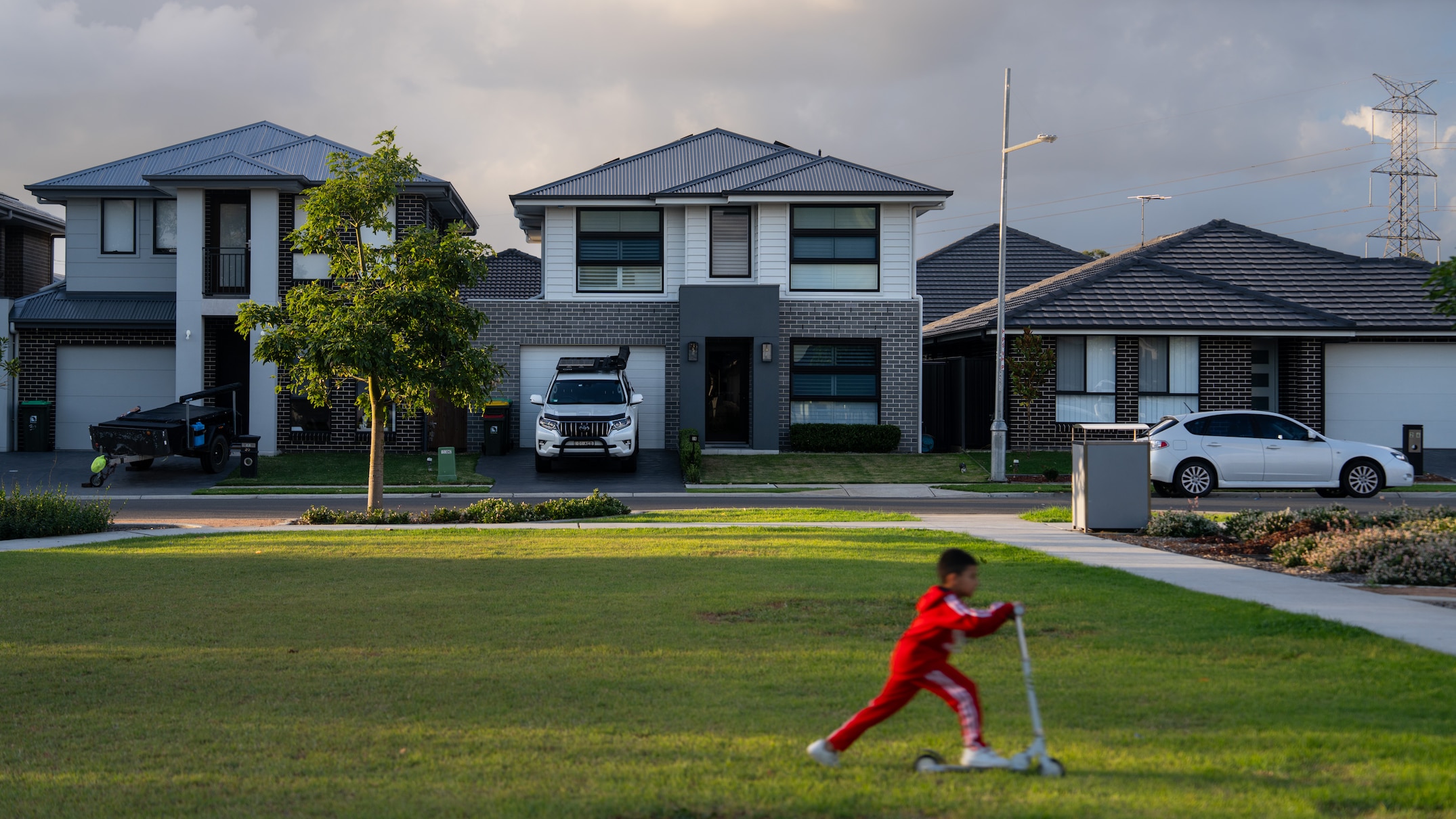
Miniature bicycles and scooters are sprinkled across mown lawns and shoes piled in front of doors that gape open to the street.
But peer through the window of every fourth or fifth home and you'll find it empty — or under construction.
Suburbs like Austral and Oran Park, on the farthest frontiers of south-western Sydney, barely existed 15 years ago. Driving towards the developments, a street sign declares "Cowpasture Road", a nod to the area's former life.
Now the region is amongst the fastest growing in the country and an example of what both major party leaders see as an answer to Australia's entrenched housing dilemma.
Labor and the Coalition have hinged their election hopes on
billions of dollars worth of promises
They claim this will simplify things for first-time homeowners trying to enter the property market.
Although many prominent campaign promises center around assisting Aussies who are trying to save enough for a house deposit, both Anthony Albanese and Peter Dutton have pointed out that housing supply is at the heart of the matter. They emphasize that promoting new developments is key to addressing this challenge.
In the Liberal-National coalition’s perspective, this appears as follows:
isolated single-family residences constructed on formerly uncultivated grazing lands
.
"Should the Coalition be elected on May 3rd, this could represent the future for numerous young Australians," stated opposition housing spokesperson Michael Sukkar at an early point during the campaign near a construction site on the outskirts of Melbourne.
As such, the opposition has committed $5 billion explicitly towards accelerating "supportive infrastructure," including roads and sewage systems for new greenfield projects. They claim this initiative could lead to the creation of approximately 500,000 additional dwellings.
The Labor party envisions a more comprehensive approach that involves denser development nearer to city centers. However, they also plan to allocate $1.5 billion for distribution among state and local authorities to facilitate the creation of new suburban areas.
Already these so-called greenfield developments — houses built on previously bare land, just as the name suggests — are changing the terrain of Australia's cities.
Once upon a time, residential growth focused mainly on areas close to economic hubs, but nowadays it’s spreading outward so much that the link to urban living has become quite weak at times.
Oran Park — constructed on the grounds of an old racetrack approximately 50 kilometers away from Sydney’s central business district — housed only around 200 inhabitants back in 2011. However, this number surged to over 17,000 individuals ten years later. Projections suggest that by 2046, the population will expand further to an estimated 32,000 residents.
In neighboring Catherine Fields, the population is expected to surge from approximately 3,000 residents this year to over 20,000 within twenty years.
The swift expansion has brought about various difficulties, yet just under two weeks before the election on a bright day, Oran Park’s town center looks like something taken directly from a brochure.
Two adolescent females have a picnic beside a mobile mammography unit stationed near a recently constructed library in the park. This location is within walking distance of an active commercial area where parking spaces are readily available upon your arrival.
Just moments away, traffic circles guide motorists into an expanse adorned with well-kept gardens and homes featuring four bedrooms. Homeowners relax inside their spacious garages, doors wide-open to let in the fresh air. Children play unrestricted in recreational areas scattered throughout the neighborhood, while mothers stroll infants in prams along the network of sidewalks. Above, the expansive open skies evoke a sense of rural charm rather than urban sprawl.
Oran Park feels like paradise to us," remarks Gaurash Bakshi, a father of two young daughters who bought his initial home in the area around two years back. "The house is fantastic, Oran Park is wonderful, and everyone here is incredibly pleasant.
The only drawback is that within ten years, he worries his daughter might ask to relocate to an apartment in the bustling CBD area downtown.
Sold the idea of connectedness
Outside an early voting station established in Oran Park's downtown area, Gaurav is candid: "I feel excluded."
Similar to the politicians, he thinks that constructing additional homes is the answer to the housing crisis. In his view of Sydney, the sole method to achieve this is through outward expansion.
His family were able to buy their home, a two-story build with a double garage, in part thanks to the First Home Buyer Scheme, introduced under Scott Morrison and expanded by Labor.
He mentions that they used up their entire lifetime savings for a promise, which was about getting connected.
The government has recently severed connections between the southern and western parts of Sydney.
In the heart of Oran Park stands a sign indicating where a metro station is planned, yet Gaurav has grown skeptical about seeing it finished anytime shortly.
"Frankly it will not be me, it will be the next generation," he says. "We pay fair share of taxes, so the federal government owes us a fair share of infrastructure funding."
This frustration over what he believes is a disconnect between what was promised and what, so far, has been delivered followed him to the ballot box. He voted Labor at the last election, but not this one.
On his charge sheet: the cost of his mortgage repayments ("Jim Chalmers was often seen smiling on some of those interest hike videos") and what he sees as the state Labor government's failure to progress the Western Sydney aerotropolis ("now it's called aerofloppylus"), located about a 15-minute drive from Oran Park.
The latter was the impetus to move to the outer edges of the city. Not only could he afford a bigger home for his two girls, he believed the promise of a "third CBD" attached to the international airport would allow him to find work closer to home.
Currently, to get to work in North Sydney, Gaurav has to drive almost 20 minutes to Campbelltown or Leppington — the two nearest pre-existing economic centres — and pray he can find a park at the train station before embarking on his more than hour-long commute.
"Chris Minns and Labor has to go, I don't see any other way," he says.
The comment highlights an enduring problem for federal governments: It doesn't matter if the states are responsible for an issue, you'll probably end up wearing some of the blame come election day.
This week, an alliance of eight Western Sydney city governments, known as The Parks, called for increased federal funding in their region. They based this request on findings indicating that "expanding zones" experience 61 percent less availability to public transportation compared with long-standing neighborhoods.
Among their key campaign promises are increased financial support for essential infrastructure projects, finishing the entire North-South railway line by 2026, and pledging to enhance road capacities.
Redrawing the electoral boundaries has moved Oran Park and the adjacent Catherine Field development from the secure Labor constituency of Macarthur to Hume, which has been represented by Liberal Party frontbencher Angus Taylor since 2013.
This reallocation caused Hume to lose a large portion of rural New South Wales, reshaping it into an urban district that was only 15 percent of its original area.
Even after the revamp, it stays comfortably Liberal at 6.9%, yet a closer race is emerging in the nearby electorate of Werriwa.
With an eye on the mortgage belt, Peter Dutton chose the marginal Labor-held electorate — which takes in some of the south-west Sydney developments — as the site for his campaign launch earlier this month.
The new borderlands
Emily-Rose Barake lives down the road from Gaurav, across the road from a playground where she is sitting at golden hour watching her daughter zip around on a scooter. Next to her, a dad and his young boys play "backyard" cricket with plastic stumps.
When she relocated to the development over three and a half years back, the area was enclosed with fencing, and from her front window, she could see a field frequented by kangaroos. These creatures occasionally visit even today, yet what used to be an open field is now just another street lined with homes.
She mentions that this park was once deserted but now it's bustling during these hours.
Observing how that developed has been truly captivating, watching it all come together.
And then for my husband, who spent his childhood here, to see how much it has changed—from the dirt roads of his youth. However, I believe he appreciates having all the facilities nearby now.
Emily-Rose moved to Australia from a country village in England and says the convenience of suburban living was a drawcard. Both she and her husband work in the area, so she's not bothered by the lack of public transport on their doorstep.
She expresses her dislike for how compact everything is," she mentions. "I find it odd being in such a large home with neighbors so close by, coupled with only having a tiny backyard considering the size of the house.
The route connecting Austral and Oran Park meanders through both past and present landscapes. On one side, you'll see time-worn cottages interspersed with vast stretches of agricultural land, while on the opposite vista, rows of slate-grey rooftops crowd together along the skyline.
For people who aren’t part of these projects and have been living there since well before government workers deemed them “priority growth areas,” the changes bring both advantages and disadvantages.
One side of the issue is the new shopping center nearby. However, this comes with increased traffic. As Vic from Harrington Park, a lush suburban area south of Oran Park, points out: “The journey out of here takes more time than traveling on the freeway.”
Despite this, he concedes that fresh constructions, such as those emerging around him, form part of the answer, complemented by additional residences nearer to downtown. “There isn’t just one fix; it’s not a single miracle cure,” he states from outside the early voting station.
Lachlan, 24, recently moved back in with his parents in Cobbitty, another of the smaller, semi-rural suburbs that neighbours Oran Park. "There's less to do for young people, I think is the main thing," he says. "Library, uni, work, gym, that's about it, that's all I find myself doing."
In Australia, Jay, who is 30 years old, offers a comparable evaluation. He points out that there are now a few food trucks setting up along Fifteenth Avenue, which is the main street in his suburb. Every location has both positive and negative aspects, he remarks with a shrug.
Prior to January, Lachlan resided in Glebe—a typical inner-city, Federation-style terraced area frequently contrasted with the extensive modern constructions at the outskirts of town. He continues to travel there for his job.
Purchasing his own home isn't feasible right now. Although that remains an aspiration, he wouldn’t mind renting long-term either—provided there were more robust protections for renters in place.
As for
What proposals are being presented in this election?
He isn’t keen on the Coalition’s proposal allowing first-time homebuyers to use their superannuation for a down payment and hopes both parties will seriously discuss modifying negative gearing rules instead.
The Coalition's prominent housing policy also involves permitting first-home purchasers to deduct mortgage interest from their taxes, though this benefit applies solely to newly constructed homes.
In the meantime, Labor has allocated $10 billion to construct 100,000 new residences designated solely for first-home purchasers. They have also committed to expanding the First Home Buyers initiative, enabling newcomers to the market to acquire a property with only a 5% down payment. The Coalition plans to broaden the scheme’s eligibility as well, though not quite to the same degree.
"I believe constructing additional homes isn’t necessarily detrimental, but we ought to pay greater attention to the environmental impact of these developments,” remarks Lachlan. He also brings up the still-unrealized subway stop, along with the “
urban heat islands
that have emerged as the city has expanded.
However, he has no intention of staying long enough to witness whether the infrastructure improves. "Given where I am in my life right now, the city aligns better with what I need," he explains.
What matter concerns you most in this federal election? Do you have any specific queries?
Experiencing difficulty viewing this form? Give it a try
this link
.
Credits
Words and production:
Photographs:



Comments
Post a Comment